Tuesday, 20 November 2012

Chris Cunningham


We were given a DVD of Chris Cunningham's work to review. He is a director of music videos for a range of different artists such as Madonna and Bjork, has even created art installations and directed short movies and has created cover artwork through photography for various music artists. 

His work is very different and strange and a lot of the time you don't really know what is going on because there is so much happening at once.  They are an insight into his thoughts and how his mind sees things. His use of CGI to create strange imagery and different camera angles bring out the unique ideas that he has to bring to videos.


There is a lot of CGI used in this video in order to get her face to look realistic and believable on the robot. A lot of time and consideration must have been put into making the video and it shows, it is very technical and one his more beautiful pieces. 
Overall, I think that even though his work is bizarre most of the time, his effort put into making videos is much more impressive. 

Wednesday, 26 September 2012

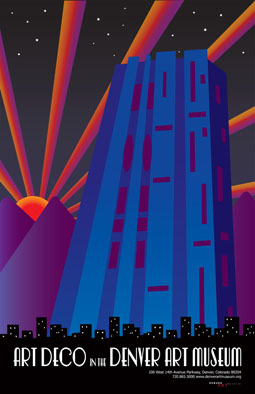
Art deco or Deco, is an influential visual arts design style which first appeared in France during the 1920s, flourished internationally during the 30s and 40s, then waned in the post-World War II era. It is an eclectic style that combines traditional craft motifs with Machine Age imagery and materials. The style is often characterized by rich colors, bold geometric shapes, and lavish ornamentation.
During its heyday Art Deco represented luxury, glamour, exuberance, and faith in social and technological progress.
Deco emphasizes geometric forms: spheres, polygons, rectangles, trapezoids, zigzags, chevrons, and sunburst motifs. Elements are often arranged in symmetrical patterns. Modern materials such as aluminium, stainless steel, Bakelite, chrome, and plastics are frequently used. Stained glass, inlays, and lacquer are also common. Colors tend to be vivid and high-contrast.
Art Deco was a globally popular style and affected many areas of design. It was used widely in consumer products such as automobiles, furniture, cookware, china, textiles, jewelry, clocks, and electronic items such as radios, telephones, jukeboxes. It also influenced architectureinterior designindustrial designfashiongraphic arts, and cinema.

Monday, 10 September 2012

Future prospects

I would like to go to University to study something in the are of English, Media and Journalism.
http://courses.wlv.ac.uk/course.asp?code=FI006J31UVD
Here is a link to Wolverhampton University which offers a course for English and Film Studies. I really enjoy English and I think that from the course I currently do, I will be able to get onto this University course.

http://www.rave.ac.uk/prospectus/undergraduate/
Ravensbourne University is far away however I think that it would be a good way of getting away from home and finally doing things for myself. They have good courses on offer including Photography and Digital Film Production. I think that if I didn't go into Photography I would go into media/film/english studies as it is a wider range than photography and I am more likely to get more jobs with these subjects.

http://www.staffs.ac.uk/courses_and_study/courses/photojournalism-tcm429196.jsp
Here, Staffordshire University offer a photojournalism course, this broadens job aspects as there is more in photojournalism.

Entry Requirements: Typical offer: 240 UCAS points. A Levels: CCC. BTEC: MMM Foundation Art and Design. All applicants are individually assessed via portfolio and interview.

I think that realistically I will be able to achieve these grades by the end of the course.

http://www.tees.ac.uk/undergraduate_courses/Media_&_Journalism/BA_(Hons)_Media_Studies.cfm
I would also consider this course because I know that this is a very good university as I have visited often from living in the area.

Friday, 6 July 2012

The history of the camera can be traced much further back than the introduction of photography. Photographic cameras evolved from the camera obscura, and continued to change through many generations of photographic technology, including daguerreotypes, calotypes, dry plates, film, and digital cameras.
Photographic cameras were a development of the camera obscura, a device dating back to the ancient Chinese and ancient Greeks, which uses a pinhole or lens to project an image of the scene outside upside-down onto a viewing surface. 
The first partially successful photograph of a camera image was made in approximately 1816 by Nicéphore Niépce using a very small camera of his own making and a piece of paper coated with silver chloride, which darkened where it was exposed to light.

From here, photography has come a long way. Now, there are digital cameras that can have different lenses, perfectly clear and crisp images and super fast capture. They can be instantly printed and can be stored digital forever. By 2010, almost all mobile phones featured built-in high resolution digital video cameras and many cameras featured built-in GPS, allowing for automatic real-time geotagging.

The Canon EOS (Electro-Optical System) autofocus 35 mm film and digital SLR camera system was introduced in 1987 with the Canon EOS 650 and is still in production as Canon's current DSLR and recently released Canon EOS Mirrorless interchangeable-lens camera (MILC) systems. As of 2007, Canon has released no fewer than 40 EOS SLR camera models, starting with the introduction of the EOS 650 in 1987. Through the tracking of eyeball movements, EOS cameras equipped with eye-controlled focusing (ECF) are able to choose the appropriate autofocus point based on where the user is looking in the viewfinder frame. ECF comes especially useful in sports photography where the subject may shift its position in the frame rapidly.

Thursday, 12 April 2012


Tutankhamun was an Egyptian pharaoh of the 18th dynasty (ruled ca. 1332 BC – 1323 BC in the conventional chronology), during the period of Egyptian history known as the New Kingdom. He is popularly referred to as King Tut.
The 1922 discovery by Howard Carter and George Herbert, 5th Earl of Carnarvon of Tutankhamun's nearly intact tomb received worldwide press coverage. It sparked a renewed public interest inancient Egypt, for which Tutankhamun's burial mask remains the popular symbol. Exhibits of artifacts from his tomb have toured the world. 

Tutankhamun was buried in a tomb that was small relative to his status. His death may have occurred unexpectedly, before the completion of a grander royal tomb, so that his mummy was buried in a tomb intended for someone else. This would preserve the observance of the customary seventy days between death and burial.
King Tutankhamun's mummy still rests in his tomb in the Valley of the Kings. On 4 November 2007, 85 years to the day after Carter's discovery, the 19-year-old pharaoh went on display in his underground tomb at Luxor, when the linen-wrapped mummy was removed from its golden sarcophagus to a climate-controlled glass box. The case was designed to prevent the heightened rate of decomposition caused by the humidity and warmth from tourists visiting the tomb.
Tutankhamun seems to have faded from public consciousness in Ancient Egypt within a short time after his death, and remained virtually unknown until the 1920s. Eventually the location of the tomb was lost because it had come to be buried by stone chips from subsequent tombs, either dumped there or washed there by floods.

Wednesday, 29 February 2012

Dan Mountford

I came across Dan Mountford's work just browsing and I think his work is really inspiring and amazing. I like how he uses photography to create what looks like pictures montaged together, when really he has used all in-camera techniques (double exposure) and simply removed parts and edited colours using Photoshop and Adobe Illustrator.


The Butterfly Lion is one of my favourites from his work. There are no Photoshop overlays, the only thing edited in Photoshop is the colours, the actually images were created in-camera by double exposure. I think is very creative and talented as he is able to capturing beautiful images and create amazing piece of work. It is unique and his style has soft colours most of the time, following a similar colour scheme, or using black and white. Also, my favourite out of his black and white work is Vall // Old Brighton Pier. It looks simple, but at a close look you can see the time and effort that has been put into these shots and getting them precise. It gives off a peaceful sentimental looks, and all of his work looks welcoming and interesting to look at because of how visually unique and unusual it is.

He also does hand made illustrations.


I love this illustration. He created the antlers by using coffee which made the brown stained look. As for the body, they are made using simple individual straight lines, showing the effort put into it. I think that the use of colours are effective and I like the fact that they aren't the typical deer colours, they're bold and the mixed media of coffee and ink makes a great effect. Also, the fact that there are only two colours make it much more effective than if there was lots of other colours mixed in with it. I would like to try and incorporate some of his style into my own work and experiment with some of the the things he has as they're individual and really do create some wonderful effects.

Friday, 3 February 2012

Website Review

I'm going to critically review four different websites, depicting their downsides and what is good about them. The Computer Arts magazine, Creative Review, Boneshaker magazine and Vasava.

The first one I have chosen is the Computer Arts magazine website, I like this website because I think it is well designed and set out in a way that is appealing to the eye. There is good colour usage, the same colour scheme follows throughout the website and it gives it a clean look with a simple white background. When you open an article, the theme is similar to the homepage, following a simple design with text and images in a uniform down the page. Image, text, image, text. I like how simple the toolbar is at the top of the page, it has good positioning and easy for the users to find.

Next, I looked at the Creative Review website. There is much less colour to this website, it is much more formal. The images on the website are the only things that bring colour to the page, the design is made up of greys, blacks and white. There is simple easy to read font that is friendly to the user however, I am not so keen on this website and I was the previous. Personally, I don't think that it is that interesting. It lacks colour, and it doesn't match what the company is promoting. 'Creative' is meant to involve the imagination or original ideas, and as far as I can see this website does not show anything creative in it's design. Also, I do not like how when you hover an image or an article, it turns yellow. It doesn't really look aesthetically nice to block things out with yellow.

Boneshaker magazine website is well designed. It is simple yet effective and easy for a user to access and get around. It uses simple soft colours with cute illustrations at the top relating to cycling, this gives the website a welcoming feel and relevance to what the site it about.. The shop page has it's own different illustration and I think this is effective, it shows the different design ideas put into the website, andnot just a plain layout on every single plage. I think that this is a successful website, it is appealing to look at, it is easy to get around and it is welcoming for their target audience, cyclists.

Vasava is my favourite website out of the four I have researched. It's design is unique and fits to the side of the browser, making good use of the space provided for websites. I like the fact that at first, all of the images appear to be black and white but when you scroll over them with the cursor, their colours return, highlighting the image you are on, giving appreciation to itself before you scroll over to another. The tool bar to the left of the page is useful, allowing you to pick a topic of what you would like to look at, it then refines your search into the catergory that you chose. Also when you scroll down, a small arrow apears to the right hand side that will take you back to the top of the website, it is a hand tool for websites that use endless scroll. I think that this website is the most effective, it is striking in design and is a great idea to show all of the images together.